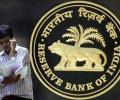
The Reserve Bank of India (RBI) on Friday kept key repo rate unchanged at 4 per cent in view of rising inflation and faint signs of economic growth amid gradual lifting of coronavirus (COVID-19) lockdown. The central bank's newly-constituted monetary policy committee (MPC) began its three-day meeting on October 7 and maintained the stance as accommodative. It also kept the reverse repo rate unchanged at 3.35 per cent.
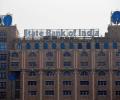
State Bank of India's latest report highlights a 'chalk and cheese' divide in the Reserve Bank of India's recent policy communications, with the Monetary Policy Committee minutes showing a hawkish tone while the Governor's statements are more data-dependent, leading to market uncertainty regarding future interest rate hikes.

The RBI is fully aware that the high-cost loans and high indebtedness of the borrowers could pose financial stability risks, if not addressed by these NBFCs. Governor Shaktikanta Das has issued a stern warning, saying the RBI is closely monitoring these areas and will not hesitate to take appropriate action, if necessary, if the culprits don't opt for self-correction. Watch out for some action, soon, notes Tamal Bandyopadhyay.

Short-term lending (Repo) rate is unchanged at 8 per cent.

The Reserve Bank of India's Monetary Policy Committee (MPC) has commenced its three-day meeting, with a majority of economists and bankers anticipating a 25 basis point rate hike to counter escalating inflation risks, particularly from West Asia conflicts.

Benchmark policy rate unchanged at 6.75 per cent.
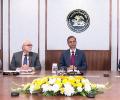
'We never waste a crisis. There will be learning and the supervisory tools will get better with each episode.'

The RBI has cut key rates to boost the economy.
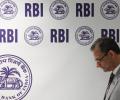
The Reserve Bank of India on Wednesday raised its policy repo rate by 25 basis points to 5.50 per cent, beginning a rate-hike cycle as rising inflation risks, elevated global yields and resilient domestic growth strengthened the case for tighter monetary policy. The decision by the Monetary Policy Committee marks a shift from its August policy, when it kept the repo rate unchanged at 5.25 per cent and retained a neutral stance while seeking greater clarity on the inflation outlook and growth-inflation balance.


Next bi-monthly policy statement on September 30.

Short-term lending rate unchanged at 7.75 pc.

This Statement consists of two parts: Part I. Annual Statement on Monetary Policy for the Year 2007-08; and Part II. Annual Statement on Developmental and Regulatory Policies for the Year 2007-08.
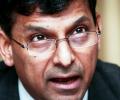
The central bank kept cash reserve ratio unchanged at 4 per cent.

Amid expectations that the Reserve Bank may keep its monetary stance unchanged, the central bank will come out with its second quarter review of the credit policy for the current fiscal on October 27.

Baby steps are pleasing to see, but when it comes to policy-making, one has to see where they go. Policy statements rarely provide the specific rationale for the proposed "baby steps". Economists, who see "baby steps" as "interest rate smoothening", infer a rationale for such actions in a variety of ways, as for example from the minutes of the policy meetings where they are made available.

These are the highlights of the seventh bi-monthly monetary policy statement for 2019-20 by the RBI amid COVID-19 pandemic:
The fund said oil prices are still at double the levels recorded in end-2006, even after the 40 per cent fall in prices from the peak they reached in July this year. Food prices too are still above end-2006 levels. Because of this, fuel importing low-income countries will see their import bill increase by 3.2 per cent of their GDP, while food importing countries will spend additional amount equivalent to 0.8 per cent of GDP on food.

This is the fourth consecutive time that the RBI has kept key interest rates unchanged despite clamours from the industry to cut rates to boost economy.

Inflation to peak in the current quarter within tolerance band, moderating in the second half of next fiscal, says central bank.

Subbarao's annual statement will be of unusual interest this year

The central bank was widely expected to maintain status quo.

The RBI has set up a panel to review ATM charges, and fees levied by banks.

Members of the Reserve Bank of India's (RBI) Monetary Policy Committee (MPC) have indicated that interest rate hikes may be necessary sooner rather than later, as headline inflation is projected to rise from its current benign levels in the coming months, according to the minutes of the August review.

'A balance had to be struck between the economic cost of taking action at this point against the need not to fall behind the curve in controlling inflation and anchoring inflation expectations.'
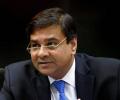
This time the all-powerful interest-rate setting panel, whose constitution was notified by the government on Thursday, will take call on interest rate. But that's not the only change. The Reserve Bank of India has also decided to change the timing of announcement of its policy review, due next Tuesday, to mid-afternoon.

Gold futures experienced their seventh consecutive daily decline, falling to Rs 1.5 lakh per 10 grams, driven by escalating military exchanges between the US and Iran which have pushed oil prices higher and intensified concerns over inflation and potential interest rate hikes.

Gold prices in India extended their losing streak, falling by Rs 1,500 to Rs 1,60,900 per 10 grams, influenced by hawkish remarks from Federal Reserve Chair Kevin Warsh and rising oil prices, which have increased expectations of an interest rate hike.
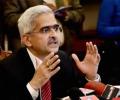
Following are the highlights of the RBI's first monetary policy statement of 2022-23 unveiled by Governor Shaktikanta Das: Policy repo rate unchanged at 4%; marginal standing facility rate & bank rate too remain unchanged at 4.25%. Monetary stance to be accommodative with focus on withdrawal of accommodation to keep inflation within target. GDP growth projection for FY'23 slashed to 7.2% from 7.8%; growth projections based on assumption of crude oil (Indian basket) price at $100 a barrel during FY'23. Inflation forecast hiked to 5.7% for FY'23 from 4.5%.

US Federal Reserve Chairman Kevin Warsh has picked former RBI governor Raghuram Rajan, Harvard University economics Professor Raj Chetty and Microsoft XBOX CEO Asha Sharma to be part of task forces constituted to examine the central bank's approach to monetary policy and propose transformational changes.

"It is heartening to note that the RBI has chosen growth over monetary tightening and inflationary fears," FICCI president Harsh Pati Singhania said.

Legendary economist and former Federal Reserve chairman Alan Greenspan has died at the age of 100 due to complications related to Parkinson's disease, his wife Andrea Mitchell confirmed.
The RBI's bi-monthly policy review on June 3 will be the first after Prime Minister Narendra Modi assumed office on May 26.

The bank chiefs have also cancelled the customary media conference after the bi-annual policies.
With inflation turning negative, industry has been demanding interest rate cuts to propel demand. However, RBI Governor D Subbarao had said there is no threat of deflation as food and crude oil prices are still firm.
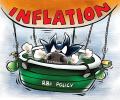
The Reserve Bank of India has increased its retail inflation projection for 2026-27 to 5.1 per cent, up from an earlier estimate of 4.6 per cent. This revision is primarily attributed to mounting input costs, driven by the pass-through of higher global energy prices to domestic petrol and diesel rates, which have seen significant increases since May.

The Indian government has introduced a 0.4% transaction fee on Unified Payments Interface (UPI) payments exceeding Rs 2,000 for merchants, effective October 15, marking the end of nearly six years of free service. Person-to-person transfers and small-value transactions below Rs 2,000 remain free. The new Merchant Discount Rate (MDR) is capped at Rs 300 for transactions above Rs 75,000, with differentiated rates for essential sectors and investments, and safeguards to prevent costs from being passed to consumers.

RBI Governor flayed easy monetary policy of central banks in advanced economies saying it is "more cause than medicine".

The Indian government has introduced a 0.4% Merchant Discount Rate (MDR) on UPI person-to-merchant (P2M) transactions exceeding Rs 2,000, effective October 15. This move ends nearly six years of fully free UPI payments, though person-to-person (P2P) transfers and small P2M payments remain free. The charges aim to bolster investment in UPI infrastructure, with specific exemptions and caps for essential sectors.

"Our endeavour is to bring headline inflation in line with the target over the medium term," said RBI Governor Sanjay Malhotra, addressing concerns about the central bank's policy stance and economic outlook.
